Bitcoin is widely considered to be the world’s leading cryptocurrency. Builders can also use the technology to create powerful apps, protocols, products and services. Over time, several ecosystems have emerged to take Bitcoin’s place. Stacks is continuing to witness tremendous growth.
The Ongoing Evolution Of Stacks
Many may be familiar with Stacks, which was formerly known as Blockstacks. It’s a smart contract layer that ties Bitcoin to the blockchain using a cross chain consensus mechanism. Every block in a Bitcoin network is encoded with the hash of Stacks. More importantly, Stacks is not limited to Bitcoin’s scaling – or lack thereof – as it relies on a different approach to process transactions.
The Stacks network is built on the following types of blocks.
- Anchor blocks: To tether Stacks with Bitcoin
- MicroblocksApplications that require high throughput or low latency.
Hiro, a company that builds Bitcoin applications is one of the partners emerging through Stacks. The organization sees merit in scaling Stacks further through Hyperchains, and increasing throughput further. Hiro suggests using trusty federated hyperchains in order to develop into a trustless solution.
The adoption rate of stacks is rapidly increasing
Stacks launched its smart contracts in 2021, and immediately adopted the Stacks approach. The Total Value Locked increased after native-BTC swaps were introduced and the support for non-fungible tokens was added. The total value of Stacks is currently close to $100 million. Most of this can be found in the StackSwap DEX or token launchpad.
Another growth factor, as outlined in the recent TheBlock research, is the number of projects building Stacks to unlock more Bitcoin-oriented potential. Alex, Gamma Arkadiko and HeyLayer leverage the smart contract layer. This confirms that developers are eager to explore Bitcoin-capable smart contract technology.
Trust Machines, which recently accumulated a $150M war chest, has strengthened the position of Stacks. The Trust Machines team wants to become the “ConsenSys of Bitcoin”, which may sound rather ambitious to onlookers. It will explore every opportunity that the Bitcoin ecosystem offers, but the first focus will be on the Stacks ecosystem.
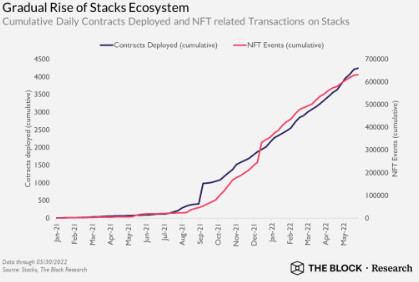
According to statistics, there has been a significant uptake of smart contracts and NFTs. While the growth in smart contract deployments and NFT events coincide is not to be expected. There will likely be many other uses for these contracts.
The push continues
Although Stacks is experiencing tremendous growth, there’s still much to be done. Developer incentives are one of the key points. The development of Bitcoin and other cryptocurrency will be more successful if there are more interested people. The Stacks Foundation, along with OKCoin and GSR, announced a $165million incentive called Bitcoin Odyssey. This fund provides financial assistance to developers and applications who promote Bitcoin adoption.
It is important to think about how developers feel secure when using Stacks. One of its core benefits is maintaining a design approach that doesn’t require changes to the Bitcoin protocol. That also extends to applications getting “stuck”, as they can resolve those issues quickly and seamlessly.


