Have you ever felt that the old-school databases you know might actually be holding your data hostage? In today’s world, choosing between the reliable client-server setup and a newer, shared network really makes a difference.
Traditional databases work fast and keep everything neat. But sometimes, they struggle with keeping things secure or growing along with your needs. Distributed ledgers, on the other hand, spread your information across lots of nodes, which can boost security and flexibility.
In this post, we chat about the ups and downs of each system to help you decide which might work best for you.
Core Comparison of Distributed Ledgers vs Traditional Databases
Traditional databases use a client-server method where one central server does all the heavy lifting. This setup is known for its speed and steady performance. It stores data in neat, organized ways and answers queries quickly, perfect for things like running an office's resource planning. But, having one main hub also means there can be issues with data security and growing system needs, especially when staff changes happen or data volumes suddenly spike.
Distributed ledgers, such as blockchain, take a different route. They share transaction records across a network of nodes, which helps keep the information secure and resilient. By cutting out the middleman, these systems make it easy for everyone on the network to see honest, untampered records. This spread-out design boosts security through a team effort to verify transactions, and it makes the records nearly impossible to destroy. In fact, this robust approach has driven spending close to $19 billion by 2024.
| Feature | Distributed Ledger | Traditional Database |
|---|---|---|
| Data Control | Decentralized Authority | Centralized Permissions |
| Architecture | Peer-to-Peer Network | Client-Server Model |
| Immutability | Cryptographic Hashing | Modifiable Records |
| Security | Consensus-Based Validation | Role-Based Access |
| Performance | Lower TPS Rates | High Throughput |
| Fault Tolerance | Node Redundancy | Potential Single Point of Failure |
Traditional databases shine in setups where you need fast performance, quick answers to data checks, and organized storage, think about financial systems or business apps. On the other hand, distributed ledgers are a favorite when keeping data honest, transparent, and secure without a central gatekeeper is top priority. This makes them ideal for things like managing supply chains or handling international financial transfers.
Architectural Models in Distributed Ledgers vs Traditional Databases
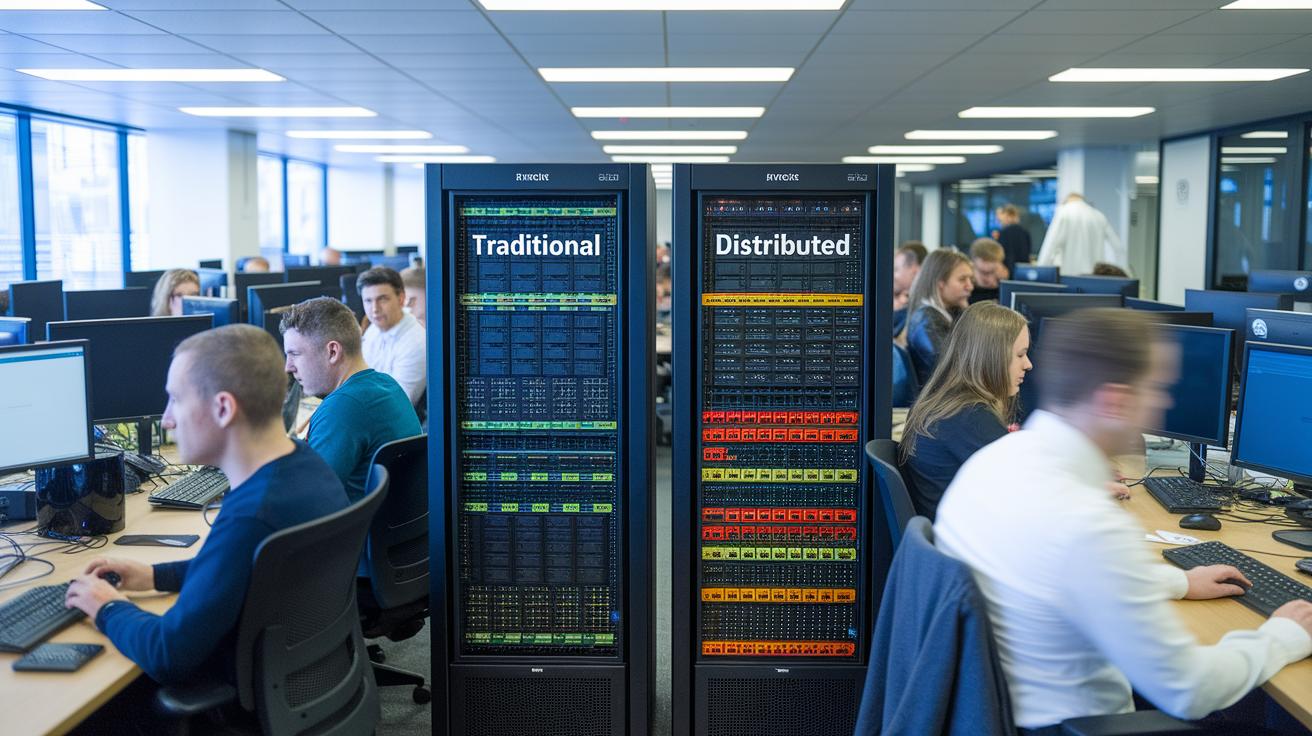
Traditional systems work a lot like a busy office where one manager handles everything. In these setups, a single server manages all data commands, much like a boss who approves every decision himself. Think of major banks processing transactions instantly through one main server, it’s quick and direct.
On the other hand, distributed ledgers spread the work among many computers. Each node keeps its own copy of the entire record. When a transaction happens, several nodes must agree on it, similar to how a group of board members would collectively sign off on a big decision. Picture a supply chain verifying a shipment; here, consensus algorithms (like practical Byzantine fault tolerance, which helps ensure all parts of the network agree) make sure the process stays secure and balanced.
- Client-Server vs Peer-to-Peer Topology
- Single Point of Administration vs Node Autonomy
- Direct Queries vs Propagated Transaction Broadcast
- Schema Flexibility vs Block Structure
- Permissioned Access vs Consensus-Based Governance
Security and Integrity: Immutability Features in Distributed Ledgers vs Traditional Databases
Distributed ledgers use clever encryption to protect data. When a new block is added, the system creates a unique digital fingerprint that links it to the blocks before it, making it nearly impossible to change past records without redoing all the work. In simple terms, any change to a block would require recalculating the fingerprints for every block that follows, which is super tough to pull off. On the other hand, traditional databases depend on user permissions, automated triggers, and audit logs to keep track of changes. But if someone gets hold of admin credentials, this central method can leave the system open to sneaky modifications.
Audit trails in distributed ledgers are open for everyone to see, meaning every transaction is recorded clearly and permanently. Imagine a public ledger where details like timestamps and unique transaction codes are visible to anyone, this openness makes it much harder for any bad actions to hide. In contrast, traditional systems often keep these logs hidden behind a central control, which might let someone cover up or change the record. This clear transparency in distributed ledgers builds trust, while the secretive nature of some traditional logs can raise concerns about data accuracy.
Another big difference is fault tolerance. Distributed ledgers are built to bounce back by copying data across many nodes, so if one node fails, the system still keeps running smoothly and safely. Think of it as having many backups in case something goes wrong. Traditional databases, however, can experience downtime if the main server goes offline, which creates a single weak spot in the system. This key difference in how each system handles problems shows why distributed ledgers might be a stronger choice for protecting sensitive data.
Scalability Considerations in Distributed Ledgers vs Traditional Databases

Traditional databases often use tricks like sharding, indexing, and replication to speed up transactions, even during busy times. For example, one bank boosted its capacity by about 30,000 extra transactions per second after fine-tuning these methods. In one test, a well-known investment firm nearly doubled its speed just by optimizing its indexing strategy. Surprising, isn’t it?
Blockchains, however, work a bit differently. Every transaction there needs the go-ahead from several nodes, which can slow things down. Even with extra layers like layer-2 solutions to ease the load, crypto platforms can noticeably slow during trading surges. In one case, a leading blockchain network saw a 40% spike in processing time during peak market activity.
When things get busy, traditional databases keep a very organized pace with structured updates. Blockchains, on the other hand, sacrifice a bit of speed to let many independent nodes check every record. Recent studies show that while centralized systems maintain near-perfect order under stress, distributed ledgers might fall behind a little but still protect the data very well.
Cost and Resource Utilization in Distributed Ledgers vs Traditional Databases
Imagine a group of computers working together like a relay team, each one running a set of rules that takes a lot of energy and computing power. Every computer uses its electricity to check and record transactions. Because each node works hard, the overall cost of running the system goes up.
In contrast, traditional databases work like a big, smooth-running engine. They use specific, powerful hardware along with licensing fees to manage all tasks on one central server. This setup means each transaction uses much less energy. It’s like comparing one big, efficient engine to many small ones that work separately.
When companies share the workload, they start to save money. With distributed ledgers, there’s no need to pay extra fees to third-party providers. This makes the system cheaper when multiple organizations work together. Even though some forecasts see investments nearing $19 billion by 2024 to meet these energy needs, the savings from cutting out middlemen can balance out the extra costs, especially when security and decentralization are priorities.
Practical Use Cases: Choosing Between Distributed Ledgers and Traditional Databases

When you’re picking between a distributed ledger and a regular database, it really depends on what you need. Traditional databases work well for things like ERP systems or apps that demand complex questions and neat data sorting. But if you need a way to keep records that everyone can trust and that can’t be tampered with, distributed ledgers come in handy.
Supply Chain Management
Blockchain can clear up the fog in supply chain management by offering a permanent record of where products come from. Imagine using your phone to scan an item and instantly seeing its journey from the factory to the store. It’s like having a built-in map that makes sure every step is recorded and everyone stays honest.
Financial Services
In the financial world, distributed ledgers give you a secure, unchangeable log of transactions, a real lifesaver when you want to cut down on extra work matching up records. Banks, for example, can use blockchain to check international transactions quickly and safely, cutting out those long delays and mistakes that sometimes pop up with manual checks.
Healthcare Records
Healthcare systems also get a boost from distributed ledgers by letting different providers share patient info safely without needing a middleman. This means patient records stay accurate and unchanged, while doctors and nurses can get the details they need in real time. It makes coordinating care smoother and keeps sensitive health information well-protected.
Challenges and Limitations in Distributed Ledgers vs Traditional Databases
Distributed ledger systems come with their own set of hurdles that you don’t often see in other systems. For instance, connecting these modern platforms with older, legacy systems usually means custom coding that stretches your tech resources. And without a central boss making all the decisions, agreeing on necessary updates can be a real headache. Plus, changing regulations add another layer of uncertainty, much like trying to fit a modern app into a decades-old accounting system, it just doesn’t click.
Traditional databases, while reliable and straightforward, aren’t always built for quick shifts. They work well under steady conditions but can fall short when new rules or tech changes force updates. The centralized setup means that adjusting things often takes a lot of time and money, kind of like rebuilding a house brick by brick.
Final Words
In the action, we broke down the differences in data control, attack resistance, and resource demands between traditional databases and blockchain systems. We examined everything from architectural design and scalability challenges to cost factors and real-world use cases.
When weighing a distributed ledger vs traditional databases, you'll see distinct tradeoffs that help shape your path in modern finance. This clear, human insight gives you confidence to step ahead in your financial decision-making.
FAQ
Distributed ledger vs traditional databases examples
The distributed ledger vs traditional databases examples include blockchain systems that record immutable transactions across multiple nodes, in contrast to centralized systems like ERP applications that operate via a client-server model.
Distributed ledger vs traditional databases pros and cons
The distributed ledger vs traditional databases pros and cons show that ledgers offer tamper-resistant, transparent records while traditional databases provide higher throughput and faster query responses, each suiting different security and performance needs.
Distributed ledger vs traditional databases pdf
The distributed ledger vs traditional databases pdf provides comparative diagrams, key features, and performance metrics that outline how decentralized, cryptographically secured ledgers differ from centralized, traditional databases.
How is blockchain different from traditional database models
The blockchain differs from traditional database models by using a peer-to-peer network, consensus mechanisms, and cryptographic hashing, which together create immutable, verifiable records instead of relying on a central authority.
What is the difference between distributed ledger and database?
The difference between a distributed ledger and a database is that distributed ledgers replicate data across interconnected nodes for higher security, whereas databases use centralized control that allows for modifications and faster transactions.
What is the difference between distributed ledger and traditional ledger?
The difference between distributed ledgers and traditional ledgers is that distributed ledgers secure records using cryptography and consensus protocols, unlike traditional ledgers, which rely on manual or centralized recordkeeping methods.
What is the primary benefit of using a distributed ledger?
The primary benefit of using a distributed ledger is achieving a secure, tamper-proof record system that eliminates the need for intermediaries, offering transparent, consensus-based data validation across the network.
What is the difference between traditional database and blockchain database?
The traditional database differs from a blockchain database by prioritizing speed and flexibility with centralized management, while blockchain databases emphasize security and immutability through decentralized, consensus-driven networks.


