Many industries are now beginning to use blockchain-based technologies such as cryptocurrencies or other forms of digital asset like NFTs. While crypto and other forms of digital currency may appear similar, there is a lot more to the hype around NFTs and cryptocurrency than about the differences in how they work in digital transactions. This includes ownership management.
NFTs are a unique asset that has attracted much interest in recent years. They allow for secure, authenticated and transparent transfer of physical objects via the blockchain. To put it simply, NFTs can be described as tokens which represent unique assets.
For art and collectibles this was a very useful feature. This allowed individuals to make NFTs to represent rare or unique pieces. If you owned an NFT, you owned the creative rights to a piece of art – verifiable by anyone just by cross-checking the NFT data on a public ledger
Yet NFTs in this form has barely scratched the surface of what’s possible, particularly when dealing with industries where non-fungibility and fungibility factors are crucial aspects.
Gamers can use NFT beyond static
DRepublic is a team of game developers who are behind Cradles: Origin of Species. They believe blockchain technology could bring about revolutionary innovations in gaming.
While some gaming companies have already dabbled in crypto and NFTs, they’ve so far been met with limited success. NFT attempts that are well-known have attracted a significant backlash in the gaming industry. The ire drawn by NFT experiments like that of Ubisoft can be traced back to the simplistic implementation of NFTs in games, either as an alternative currency or as a way to generate more money for the company by generating even more “unique” items like skins. In other words, NFTs in gaming so far have only served to further the much-maligned “lootbox” mentality perceived by many gamers as plaguing game developers.
Developers of Cradles seek to transcend the static NFT features that made them so beloved among speculators by creating a new type NFT token using what they call EIP-366 protocol. Technically, this is a naming convention for a proposed set of rules on the Blockchain. It expands on ERC721 (and ERC1155) NFT standards.
EIP3664 NFTs are able to provide far more information than normal NFTs. They will enable all elements of the game to possess many more attributes, which can be combined with other elements in various ways. This simply refers to the fact that components can be added or removed from one another in game language.
Combineable game elements with a virtual world that is time-lapping
This is how component NFTs are described. A player could create, participate and fully control the virtual universe by combining NFTs from characters, objects, plants, animals, and other items. You could take raw materials and create weapons and tools from them. Attach these items, including weapons, clothing, skills, and tools to create a new character. This character will have all of the attributes from all its components. Similar to the above, an element can be broken down into its individual parts and reconstructed as a variety of new characters or items.
The EIP-3664 protocol will allow Cradles users to change and shift their digital assets in infinite ways. This is possible by using raw materials gathered from exploring or going on adventure.
Crucially, NFTs in Cradles will also have evolvable attributes hard-coded into every component, enabling all game elements to simulate the laws of time and physics – something no virtual world has been able to properly implement.
DRepublic calls this effect “entropy-increase”. Block time is used to create a steady base for perpetually lapsing time. Each element of the game evolves over time. Block time is a constant process in which items rust and characters age. Buildings slowly fall apart, making it necessary for players to actively intervene to encourage cooperation.
You will see your NFTs as characters or items changing over time. Cradles is a game that creates a dynamic world with its own progress, changes and deterioration.
The game is all about new experiences
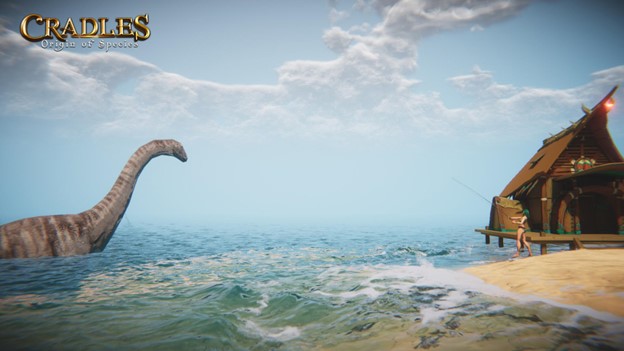
Cradles is an open world MMORPG, with metaverse elements and an ambition to enhance the traditional RPG experience.
Players of Cradles will have the opportunity to experience virtual reality games compatible with immersion hardware. They will also be able to interact with players from any animal species. This game offers players ultimate freedom and exploration as well as community building.
The game will allow players to visit two different locations, the Main City and Adventure Zone. Players will have the opportunity to interact with and explore other players in the first area, while they will also be able to gather supplies and defend themselves from possible hostilities.
It also links into the story’s spine, with characters being sent back to the past in search of answers. Cradles is an exploration-based game. Research, discovery, and research are all necessary to improve the world.
Blockchain will be a part of the Future Of Gaming
The team behind this project has raised significant funds for its development but is determined to create the conditions for an open and decentralised community which will ultimately lead to a self-sustaining game.
Its growing community aren’t just considered as gamers but as game creators. Even now, the game developers continue to work on improving the overall gaming experience by implementing new features, fixing bugs, and testing new functionalities – following the direction and feedback of its community online.
Players in Cradles can take advantage of a growing sector that will continue to attract new users and grow over the years. Dapps Radar’s data shows that the 10 top Blockchain games are worth more than $700 million and have nearly 1,000,000 active users.
It is clear that there is potential for more decentralised game development, even though the relationships between traditional developers and gamers in recent years have been fraught with frustration and disappointment.
Future games may not only be about the ability to buy NFTs and earn cryptocurrency. Blockchain technology could be the key to unlocking and enabling new aspects of gameplay that have been missing in traditional gaming.


