Celsius Network Ltd. froze withdrawals, swaps, and transfers after weeks of skepticism over the sustainability of the DeFi lending platform’s outsized returns, causing a global cryptocurrency selloff.
After the Celsius declaration, crypto markets plummeted. Bitcoin plunged as high as 14% to its lowest since December 2020. Ethereum and other tokens also fell sharply. According to data on CoinStats, Celsius’s CEL token was down roughly 50% to 15 cents as of June 13, 2022.
The crash is the latest setback for decentralized finance, DeFi, crypto’s alternative to traditional banking, providing users with greater flexibility and lower pricing and exposing them to greater risk.
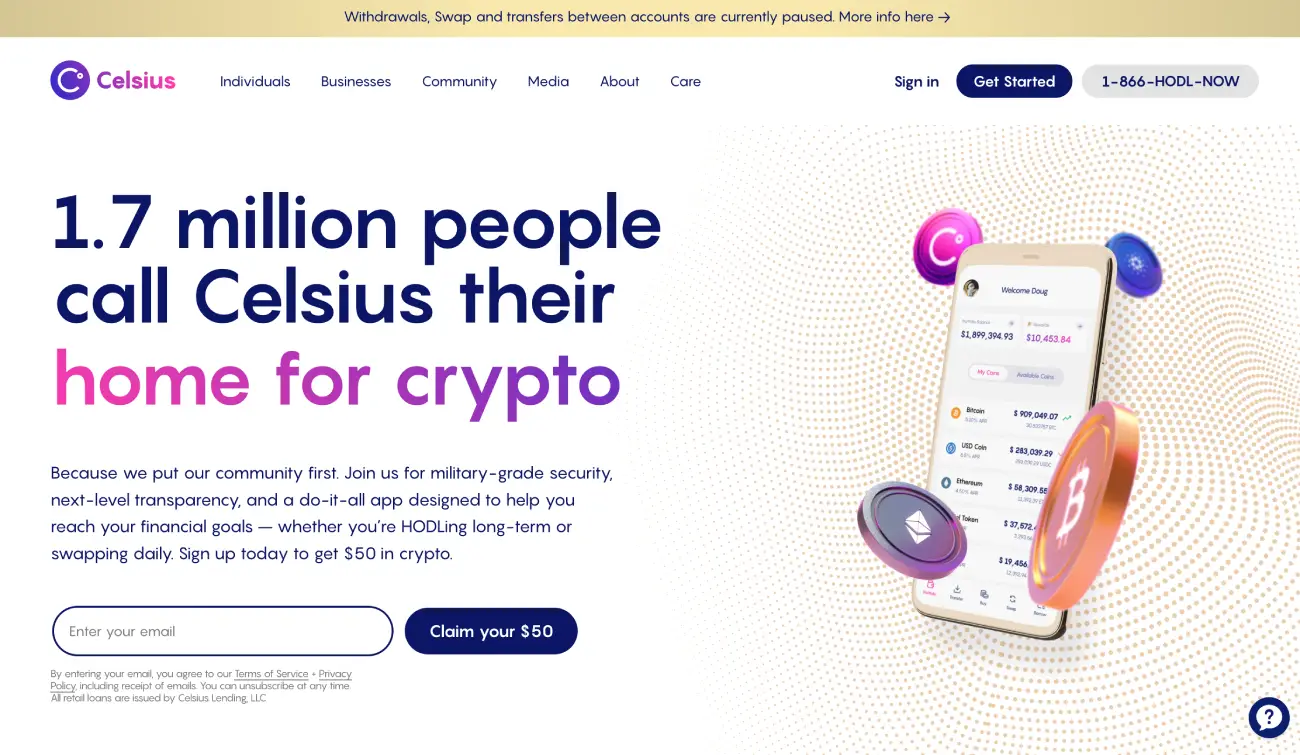
Concerns about the sky-high yields backing products such as those offered by Celsius have intensified after the Terra ecosystem’s collapse in May and as tighter monetary policy worldwide restricts demand for riskier assets. The CEL token promises “actual financial rewards,” including as much as 30% extra returns weekly.
While the market was overwhelmed by the TerraUSD (UST) stablecoin’s collapse, one of the project’s key attractions for investors had been its promised interest rate, set as high as 20% for UST deposits in the Terra blockchain-based lending venture Anchor. The project was supported by Celsius. Both projects are based on super-high return promises to sustain demand. These depend on either a steady stream of new entrants or borrowing to cover the high rates.
Nexo, a London-based rival, stated on Twitter it was willing to buy Celsius’s remaining qualified assets, characterized as “primarily their collateralized loan portfolio.” Nexo later posted a letter of intent describing the offer. According to a Nexo spokesperson, the tweets have been confirmed.
Nexo also stated they had approached Celsius to offer assistance, but the offer was turned down. A spokesperson for the company claimed in an email they had a “good liquidity and equity position.” Celsius didn’t comment on Nexo’s remark.
In response to a tweet by Mike Dudas, co-founder of The Block, Celsius Chief Executive Officer Alex Mashinsky appeared to counter speculation about a withdrawal freeze, tweeting, “Mike do you even know one person who has difficulty withdrawing from Celsius?” in a day before announcing the halt.
Celsius announced the decision, saying, “We are taking this action now to put Celsius in a stronger position to pay its withdrawal commitments over time.” Users will continue to earn incentives during the interruption, according to the company.
The news came amid turbulence in crypto markets, with worse-than-expected US inflation data on Friday fueling predictions of faster interest rate increases, hitting riskier assets like digital currencies. Bitcoin has lost 48% of its value this year, while Ether has lost more than two-thirds of its value.
The Celsius news only added fuel to the fire, instilling uncertainty in the market, said Vijay Ayyar, vice president of corporate development and international cryptocurrency platform Luno. As the Fed decision week approaches, prices are under pressure, and there are questions about the protocol’s offering high-yield products.
According to CoinStats, tokens linked to lending and borrowing protocols underperformed on Monday (June 13, 2022), with their total value down 10% compared to a 6.4% loss in the broader crypto world. Celsius counterparts Aave, Maple, and Compound, fell 12%, 15%, and 13%, respectively.
According to Ethereum blockchain statisticsCelsius is the digital wallet that holds CEL tokens the largest, holding more than 184,000,000 tokens. This represents 26.6%. Mashinsky claimed in a tweet over the weekend that Celsius is not selling its token.
‘Grey Area’
Many firms have launched offers for crypto lending in the past year. Crypto lending has been growing in popularity. This has alarm regulators who are concerned about both the risks associated with unregulated lending and how they can affect financial stability.
According to Matthew Nyman of CMS law firm, Celsius and other organizations that provide equivalent services operate in a regulatory “grey area.”
Last year, Celsius raised $750 million from investors, including Caisse de Dépôt et Placement du Québec, Canada’s second-largest pension fund. Celsius was then valued at $3.25 Billion.
Celsius’s website stated that it had $11.8 Billion in assets at May 17th, a decrease of more than half compared to October 2021. It also had $8.2 Billion in total loans processed.
Mashinsky was the Celsius CEO in October 2021. He stated that Celsius owned more assets than $25 billion.
Latest Celsius Statement
CEL token, which is currently the 153rd largest cryptocurrency in terms of market capitalization trades at $0.55. That’s an 13.67% increase over the 24 hour period.
Celsius CEO Alex Mashinsky broke his three-day silence on Thursday, saying that the company focused on its customers’ problems and was grateful to have heard from so many. “To see you come together is a clear sign our community is the strongest in the world. This is a difficult moment; your patience and support mean the world to us,” Mashinsky tweeted.
Mashinsky maintained an upbeat tone on social media, while Celsius began seeking financial advice from restructuring experts at the law firm Akin Gump Strauss Hauer & Feld LLP, according to the Wall Street Journal.
Final Words
The early May collapse of the TerraUSD stablecoin and its sister token Luna raised widespread concerns about the lucrative returns crypto lenders like Celsius, and decentralized-finance platforms had been promising investors. Before TerraUSD or UST failed, Anchor, a project tied to the Terra ecosystem, had been offering payouts of around 20%.
The collapse of Celsius’s token $CEL appears to be a realization of the UST/LUNA contagion risk into comparable financial tools, said Burak Tamac, a senior analyst at CryptoQuant specializing in regulatory and on-chain issues.
Investment Advice Disclaimer: The information contained on this website is provided to you solely for informational purposes and does not constitute a recommendation by CoinStats to buy, sell, or hold any securities, financial product, or instrument mentioned in the content, nor does it constitute investment advice, financial advice, trading advice, or any other type of advice.
Cryptocurrency is a highly volatile market and sensitive to secondary activity, do your independent research, obtain your own advice, and only invest what you can afford to lose. There are significant risks involved in trading CFDs, stocks, and cryptocurrencies. Between 74-89% of retail investor accounts lose money when trading CFDs. You should consider your circumstances and obtain your own advice before making any investment. You should also verify the nature of any product or service (including its legal status and relevant regulatory requirements) and consult the relevant regulators’ websites before making any decision.


